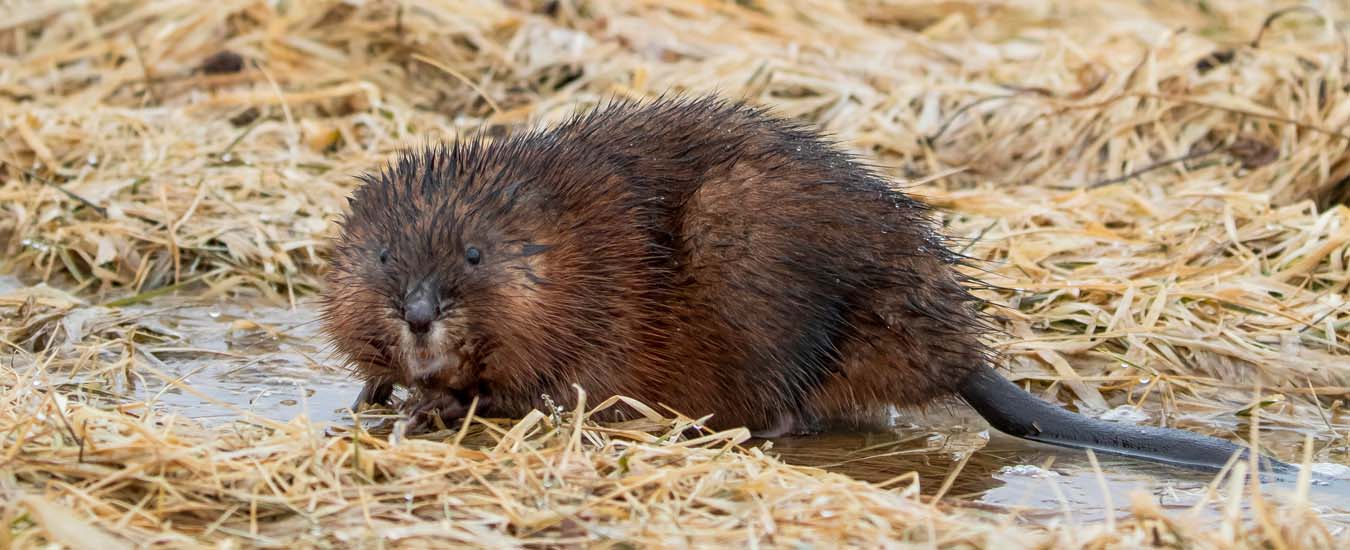
The “rodent version of a hobbit” is found throughout the region
Have you ever noticed an odd-looking bulge in the snow when walking past a pond or snowshoeing beside a quiet, weedy waterway? It’s probably a muskrat “push-up.” Under the snow, carefully plastered with mud, is a mound of grasses and reeds. Muskrat-made, the bump may be a temporary den on ice or a lodge. They chisel through the ice after freeze-up some distance away from the main lodge to erect their temporary push-ups, which are used as feeding, breathing and resting places. Ondatra zibethica is nature’s aquatic rendition of a guinea pig.
Smaller cousins of beavers, muskrats are tenacious, rotund and paunchy. This rodent version of a hobbit with soft, thick, brown fur can be found across most of continental North America, from the Atlantic to the Pacific Ocean, from the Arctic Ocean to the Gulf of Mexico.
Muskrats get their name from the musky substance secreted from glands at the base of their tail during the mating seasons. Adult muskrats weigh from two to four pounds (0.9–1.8 kg) and average 10”-14” (25-35 cm) in length with an additional 8”-10” (20-25 cm) of black, hairless tail that is compressed on each side. When swimming, that tail zigzags from side to side, functioning as rudder and for some propulsion.
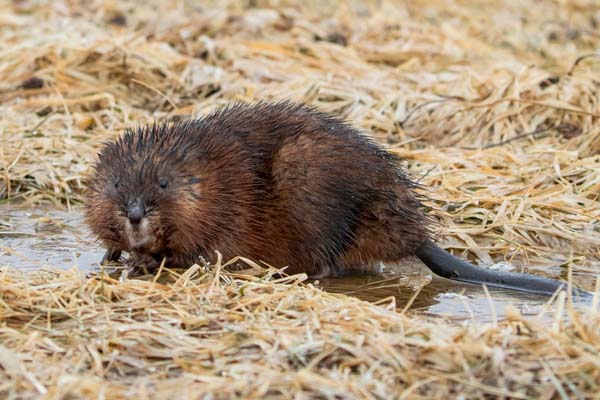
If you live near fresh or salt water, like many do in Saltscapes country, muskrats are likely your neighbours. You may be blissfully unaware until a wanderer accidentally drops into your basement window well one night and becomes trapped. Placing a board into the well that is long enough to extend up to the rim will allow this cheeky, brown bundle of fur to climb out, whenever it is ready.
This works for skunks too!
In warmer weather, muskrats dig burrows under stream, river or lakeshore banks that are sufficiently high above the water line. They dig into clay soils by using their claws, front feet and teeth. The entrance is normally underwater, with a vent hole through to the ground. Where marsh banks are low, a push-up den is constructed in shallow, weedy shoals. The “island” is hollowed out from the inside and accessed underwater.
Muskrats love to find freshly dug ponds with exposed earth banks. If numbers of them move in, their tunnels can weaken a dyke or dam. The digging completely drained one pond on our property.
Like beavers, muskrats are able to seal off their mouths behind their front teeth while using them underwater. A muskrat’s mouth has powerful upper and lower front pairs of teeth, called incisors. Unlike our incisors, these grow continually over their lifetime. The inner tooth sides are softer and wear faster than the outer side. This wear pattern maintains sharp edges, enabling them to neatly clip the stalks of plants like cattails, iris, arrowhead, lilies, reeds and rushes, for food
and bedding.
Many folks think muskrats are plant eaters (herbivores). Once I heard a chipping noise under a flimsy, wooden dock. Peeking down between the slats, I spied a muskrat chewing away on the edge of a live freshwater mussel shell. Eventually it opened the mussel and began consuming its soft meat. A muskrat’s diet sometimes includes frogs, crayfish, salamanders and fish. Not powerful like busy “tugboat” beavers or fish-chasing, “jet-ski” otters, muskrats are nevertheless excellent swimmers and divers, tucking their front feet against their stocky bodies and propelling themselves with large, partially-webbed hind feet. They manoeuvre forward or backward, and may remain quietly underwater for 15 to 20 minutes. When swimming underwater they can travel as far as 50 yards (47 metres) before surfacing to breathe. Their beady eyes have secondary, transparent lids that function like diving goggles, and their ears have valves that close whenever they submerge. When swimming in winter, they can extend their time underwater by exhaling a bubble under the ice, then rebreathing the trapped bubble before continuing onward.

Photo by Brittany Crossman
I live on a hillside overlooking a pond. Its water flows down through a marsh to the harbour, making muskrat-watching easy. With barred owls hunting them nightly, our “water rats” are safest being active during the day.
This mammal’s first breeding season in May or June is an easy time to watch pairs chugging around the pond after one another, uttering soft, mewing love sounds. Over the late spring and summer they raise two or three litters, each with four to eight young, born blind and helpless. After steady salad deliveries by adults over a two week period, plus Mom’s milk, the juveniles open their eyes and begin swimming.
Weaned at four weeks, youngsters are understandably naïve. Whenever I stand quietly by the pond, curiosity usually brings them close to see and smell me. Summer life may be initially easy for youngsters, but if food resources are limited, adults will drive them away in the fall. Clumsy and uncomfortable on land, it’s not a good time to corner or challenge them. They seem to believe that the best defense is a good offence, and readily attack.
Years ago I noticed a strange looking thin black object projecting out from under a streambank in the Annapolis Valley. Curious, I reached down in the water and picked it up, only to find a muskrat attached to it. It immediately began emitting clicking sounds with its teeth, sounding like a mad typist.
Summer is a vulnerable time. Besides owls, predators include coyotes, foxes, dogs, cats, bald eagles, northern harriers, red-tailed hawks, goshawks, bobcats and black bears. Opportunistic ospreys have even been known to take them. But their most serious adversaries are mink and otters. The lifespans of individuals tend to be short. Four-year-olds are elders in their communities.

Muskrats are excellent swimmers and divers, tucking their front feet against their stocky bodies and propelling themselves with large, partially-webbed hind feet.
One warm fall day a mink appeared on the pond in front of the house. That set off an alarm bell! Muskrats emerged simultaneously from dens around the perimeter of the pond. They surrounded the mink, body-surfing about in circles on the surface, a behaviour I had never witnessed before. Confused, the mink managed to exit, stage left, bounding off through the willows and alders, with a posse of three adult muskrats in hot pursuit!
Otters have used this pond as their winter base for many years. We watched five of them evict the resident beaver from its den one December. Their summer exuberance causes the muskrats to relocate downstream in the marsh. When otters are not an issue, muskrats and beavers tend to peacefully co-exist and sometimes
even share the same lodge or a den
in the bank.
Water rat presence can also be determined indirectly if you see piles of open mussel shells in crevices in stream banks after ice-out. These are leftovers from winter feeding. Tracks are easily spotted in the mud or snow along the waterway. Any time of the year, they leave teeth marks on cut plant stalks, and plenty of black poop wherever they are active. Small canals dug through shallow water zones are another sign.
If you visit wet areas with fresh sign in warmer weather, stay quiet and still, a muskrat may soon paddle over to inspect you. Just don’t expect it to row over in a small boat, Wind in the Willows style!