I started liking Jasper White, New England's renowned chef, restaurateur, cookbook author and recognized authority on all things seafood, when he told me that Nova Scotia's lobsters are better than Maine's. I liked him better when, in his book 50 Chowders (Scribner, 2000), he gives a nod to the possibility that chowder originated in Newfoundland and Nova Scotia. I liked it when he said, "In this land of friendly people, breathtaking scenery, and some of the world's finest seafood, chowder making is an old custom (as is rum drinking)." But I think I liked him best when, in the same book, he gives the correct pronunciation of the word scallops.
"Before we even start talking about scallops," he says, "let's get the pronunciation straight: the a in scallop is pronounced so it sounds like dollop, not gallop."
Right on!
Describing the different types of scallops, he says the medium-size scallops from Digby Bay in Nova Scotia are fabulous, but he cautions against buying the small "bay scallops" from China: "They are not the same as bay scallops from the North Atlantic, and they make an inferior chowder."
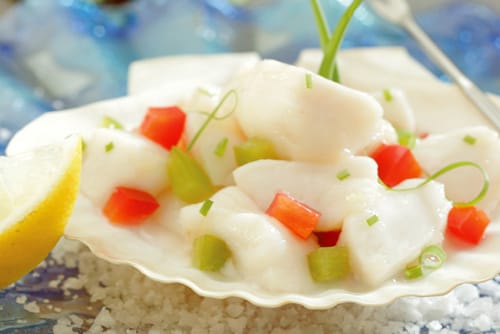
While the large and extra-large offshore sea scallops can be good in chowder, they need to be cut down in size, so you shouldn't pay extra for them if local bay scallops are available.
It's the treatment given to the scallops after harvesting that causes the biggest problems with quality-Jasper recommends asking for "dry" scallops at the fish market. Many times scallops are soaked in water (sometimes with preservatives added), which improves their colour but compromises their texture. If scallops brown up nicely in a hot pan, they're dry. Wet scallops will seep their liquid and steam rather than sear.
If you end up with wet scallops (determined by a hot pan test), chef Ray Bear, of the Prince George Hotel, in Halifax, offered this advice during a cooking demonstration at Saltscapes' first annual East Coast Expo last April: as soon as you get the scallops home, place them in a single layer in a pan lined with paper towels. The scallops will dry out nicely, and you'll have beautifully browned scallops when searing them.
Another tip offered by both chefs is to remove the muscle, or "strap," attached to the side of the scallop. It looks like a piece of scallop meat, which it is, and although the flavour is there the texture is tough. That's because it works hard at opening and closing the shell.
An average serving of scallops is eight or nine, but I like to add a couple extra for good measure.
Recipes featured in this article:
- Scallops Seviche
- Scallops Stir-Fried with Snow Peas
- Sautéed Scallops and Vegetables in Puff Pastry Shells