
An early morning chasing sturgeon on the Saint John River in Carters Point, N.B., is never just about the catch. These ancient fish, older than dinosaurs, glide like living legends, their armoured bodies bearing the marks of millennia. I join Cornel Ceapa, founder of Acadian Caviar, aboard a skiff named Stanley. We follow the fish to understand them, to witness their quiet, deliberate power, both mythical and primal. Equally striking was the reverence of those who work with them, especially Ceapa. For him, this is more than a livelihood. It’s a calling, grounded in science, respect, and purpose.
Ceapa’s journey began thousands of kilometres away on the banks of Romania’s Danube River. “My fascination with sturgeon began in 1997,” he says. “I saw one being harvested and thought, and still believe, they’re the most incredible fish on the planet.” That moment sparked an enduring obsession, and Ceapa devoted the next decade to studying sturgeon, eventually earning a PhD through a joint program between Danubius International University and the University of Bordeaux.
Ceapa’s passion came to life after a leap across the Atlantic. “Armed with everything I’d learned, I followed my sturgeon dream to New Brunswick,” he says. “The fish were here, plentiful, mysterious, and overlooked.” With five native sturgeon species, Canada is rich in biodiversity. “I’d call the Saint John River the sturgeon capital of the world. We see ourselves as stewards of this incredible resource.”
Sturgeon are prehistoric, unchanged for more than 200 million years. Long before borders or empires, these fish glided through rivers across Europe, Asia, and North America. Their size and resilience have commanded awe for millennia. Their most precious offering, caviar, has had the same effect.
In the courts of tsars and emperors, caviar was a tribute, a medicine, and an aphrodisiac. Well-made caviar like Acadian’s is a quiet link to the past: the soft pop, the saline bloom, the moment of pause. But that legacy is fragile. Overfishing, poaching, and habitat loss, especially in the Caspian and Black seas, have pushed many sturgeon species to the brink. Global demand has driven mass production, often at the cost of quality and animal welfare.
“Sustainable and ethical are big words, often misused,” says Ceapa. “The concerns don’t apply only to sturgeon but to every fish species we harvest.” He continues, “Scientists know what sustainability means, but policies often follow politics and economics instead.”
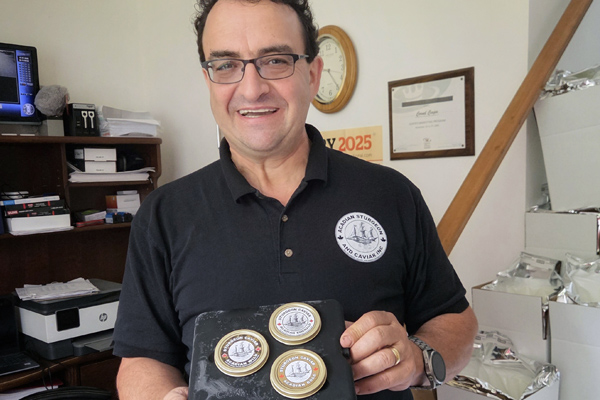
At Acadian Caviar, sustainability means a science-based wild harvest and responsible aquaculture. “Fishing and farming are two very different kinds of sustainability,” says Ceapa. “For wild harvest, we keep the catch limited and accurately based on data. We maintain a balanced sex ratio, harvest selectively, and use every part of the fish.” Ceapa has found a market for nearly every part of the sturgeon, from smoked fillets and bone marrow to tanned hides, maws, and even heads. It’s a nose-to-tail approach rooted in respect and sound economics. The wild Atlantic sturgeon fishery is one of the most tightly regulated in the world, supported by peer-reviewed science and strict oversight.
Like wine or oysters, sturgeon reflect their environment. “Fish are about 70 per cent water, so water quality heavily influences flavour,” says Ceapa. That’s why they’re raised near native waters — to preserve true “merroir” (the sea’s version of terroir). Every detail matters: water, feed, and stress levels all shape taste. At Acadian Caviar, fish hibernate in winter as they do in the wild, and farmed caviar is tested against wild to ensure equal or better quality. “Our goal is ethical, nourishing food,” says Ceapa, “because good food is powerful medicine.”
For Ceapa, honouring sturgeon means showing that true luxury can be responsible. “It’s a treat, like fine wine, meant for special occasions, in small amounts,” he says.
Running a small, ethical caviar business is hard. “There’s a real lack of awareness around sustainability and food quality,” says Ceapa. “We’re held to strict regulations, while many imported caviars, often containing borax (used as a preservative) and heavy metals, face little scrutiny.” Climate change has disrupted traditional migration patterns. With sturgeon taking over a decade to mature, sustaining long-term operations is financially daunting. “It’s a constant struggle,” Ceapa admits. “But we never give up. We keep pushing through the challenges.”
Despite its complexity, Acadian Caviar is meant to be simple and deeply enjoyable.
“Start with a caviar bump on the back of your hand,” says Ceapa. “Pair it with a Canadian sparkling wine. Caviar will elevate anything on your plate, whether it’s a cracker or a hard-boiled egg.” Most of all, he wants people to let go of the idea that caviar is elitist or intimidating. “I wish more people knew that good caviar isn’t an acquired taste. It’s incredibly healthy and likeable, even for beginners.”
Ceapa has spent a lifetime tuning into, the pulse of rivers, migrations, and ecosystems that reward patience. Acadian Caviar is more than a product; it’s a promise that taste can tell a story and true luxury lies in respect, not excess.
Tasty treasure
Acadian Caviar offers three varieties, best tasted in sequence.
- Gold: From a rare shortnose sturgeon line, this caviar is buttery, smooth, and subtly briny. Only 20 per cent of this species yields the prized golden eggs.
- Emerald: Green-amber pearls with a mild, creamy, nutty flavour and a hint of seaweed — farmed with minimal environmental impact.
- Wild: The world’s only sustainable wild caviar. Smaller grains, rich umami, and a melt-in-your-mouth texture.
Recipes