If there’s anything as close to perfection as sun-ripened strawberries, it would have to be sun-ripened raspberries, blackberries or other soft fruits. (To distinguish various types of berries, grapes and currants from tree fruits in commercial production, horticulturists refer to them as “soft” or “small fruits.”)
To get advice on berry growing, I talked to John Lewis, the small fruit specialist at AgraPoint, a consulting business in Kentville, NS. The top two pointers for berry success? Site the garden in full sun, and prepare the soil well. Dig up the area before planting either by hand or with a tiller, and add a generous amount of compost or well-rotted manure. If there are weeds, especially perennial weeds that creep such as couch grass, it’s important to get rid of them at this stage—so you’re not left trying to untangle them from strawberry runners or under raspberry canes. Mulching helps reduce the germination and spread of weeds after you plant.
As a general rule, remove blossoms from berry plants their first year in order to prevent fruit production. It’s better for the plant to put its energy into establishing itself—it will be healthier and more productive in the long run.
Sultry Strawberries
Unlike other types of soft fruits, strawberries are low-growing herbaceous perennials. They’re perhaps the most popular soft fruit for home gardens, but they can be susceptible to a number of diseases that necessitate pesticide use. “Most home gardeners don’t want to use pesticides, so the main thing is to select disease-resistant varieties and plant them with good air circulation,” says John. For disease-resistant varieties see sidebar, “33 Best-Bet Berries.”

Plants send out runners that form new plants; keep the number in check—John suggests five to eight plants/square foot—to avoid overcrowding.
There are different types of strawberries: the June-bearers are what we’re most familiar with, producing fruit to mid July. They form their flower buds for next year’s crop during the shortening days during late summer. Varieties that produce fruit later in the season are known as day-neutral strawberries—they will produce flower buds and thus fruit throughout the year, right into September and even October, depending on temperatures. There are two main types of day-neutral strawberries; double-cropping produce fruit twice per season while ever-bearing produce flowers and fruit continually throughout summer and fall.
Although it’s delightful to have fresh strawberries in late summer or early autumn, day-neutral plants don’t create runners as profusely as June-bearers; they also tend to be more susceptible to diseases.
Strawberries don’t like clay soils; amend your soil with generous applications of compost or well-rotted manure, or build a raised bed on top of the ground. Plant strawberry crowns in rows four feet apart, spacing the plants 20 inches apart to allow for runner development and good air circulation. Plants may produce fruit for four to five years; by the fourth year you’ll want to plant new crowns so they’ll be in production when you remove the old ones after the next season.
Some claim strawberries get their name from the fact that plants should have an insulating cover over winter—and many gardeners mulch with straw. Resist the urge to use hay—it often contains weed seeds.
Royal Raspberries
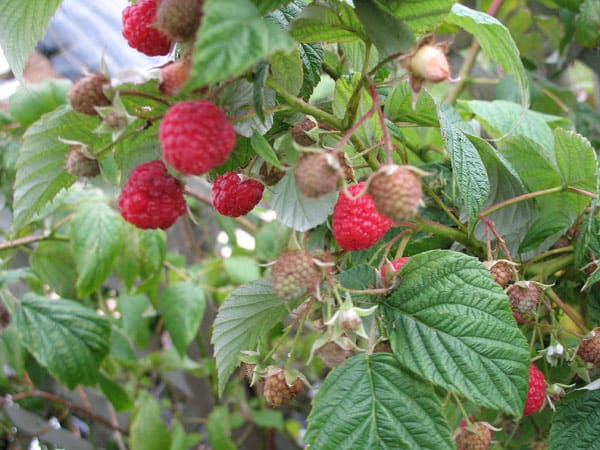
Both raspberries and their blackberry relatives are called cane or bramble fruits. Brambles traditionally take two years to bear fruit: new canes that sprout this year, known as primocanes, will produce good growth and ample foliage; next year, these canes—now called floricanes—will bear fruit then die, while new primocanes sprout for next year’s production. Instead of cutting down the spent floricanes after they’ve finished fruiting, leave them until spring. They’ll hold snow around the plants, reducing winter dieback.
Plant your canes in the spring to provide ample time to get established before cold sets in, spacing them two feet apart and in rows at least eight feet apart. It’s important to have excellent drainage in your raspberry bed—don’t skimp on the compost or manure if your soil is on the clay side.
There are now ever-bearing raspberries, which produce fruit until frost on canes from the current season rather than on last year’s canes. Thus the floricanes can be cut off in spring, unlike traditionally cropping raspberries.
While tarnished plant bug can be a problem in fall-bearing raspberries, if you’ve ever eaten raspberries off the cane in late September you know they’re divine. Some cultivars are susceptible to early frosts, although parts of Atlantic Canada have recently been enjoying a long autumn with no serious frost until mid or late October.
Golden Gooseberries and Currants
Gooseberries and currants, both members of the genus Ribes, aren’t grown as often as they once were but they’re marvellous as preserves and used in main courses and desserts. You’ll often find bushes growing around old homesteads—shrubs were brought to North America by Europeans—and both types of fruits were planted in Acadian potager gardens.
There are three types of currants: red, white and black; red and black are the most popular, primarily used for jams, jellies and cooked desserts. Gooseberries may be red-skinned or, more traditionally, are white (green).
Both gooseberries and currants grow on shrubs ranging in height from one to three metres. They prefer full sun—they’ll tolerate some shade although fruit production will be reduced—and a moist but well-draining soil. Plant them in an open site, and you’ll have far less risk of disease or frost damage than if they are sheltered with poor air circulation.
For best fruit production, currants and gooseberries need to be pruned, usually in late winter or early spring. (Gooseberries have wicked thorns on them, probably one reason they aren’t more commonly grown.) Remove branches older than three years—they don’t produce fruit.
More Fine Fruits
Highbush blueberries are another divine pick in nature’s smorgasbord. They prefer sun, good drainage and air circulation, and also acid soil. Test the soil for pH; if your soil is neutral to alkaline, you can increase its acidity (lower the pH number) by amending it with oak leaves, pine needles or peat moss. Growers also recommend adding generous amounts of compost, and fertilizing with manure tea, seaweed or fish fertilizer.
Cranberries aren’t often seen in home gardens, which is a pity. Not only are the berries tasty in preserves and baking, the vines are beautiful groundcovers with spectacular fall colour that lasts well into spring. Like blueberries they prefer well-draining, acid soils.
One of the most distinctive Atlantic Canadian berries has to be the bakeapple. This relative of raspberries grows on low plants in acid soils and produces raspberry-like fruits that are red when unripe and a golden-orange colour when ripe. They are traditionally harvested in the wild in Newfoundland and Labrador as well as in scattered locations throughout the rest of Atlantic Canada. “Theoretically, there’s no real reason why bakeapples couldn’t be cultivated in home gardens, provided you could find some plants,” John Lewis says. However, bakeapples are dioecious, meaning male and female plants are required for pollination and berry production. And that, dear reader, is a whole other story….
33 Best et Berries
The following varieties of berries recommended for Atlantic gardens come from John Lewis of AgraPoint, a consulting firm in Kentville, NS, Richard Thompson of Foggy Hollow Farms, a nursery in Noel, NS, and Bob Osborne of Corn Hill Nursery in Corn Hill, NB. You may need to shop around to find what you’re looking for—and be sure to ask at local nurseries. “More plants become available as nurseries know there’s a demand for them,” says Bob.
STRAWBERRIES
No matter what varieties you grow, always look for certified stock, produced by specialty growers and grown to specific standards.
Early
Brunswick - Known for big berries, good flavour and winter-hardiness.
Sable - Not big but sweet, high-yielding, vigorous and resistant to red stele disease. Early blossoms can be hit by frosts but later yields compensate for that early kill.
Mid-season
Cabot - Fruits in late mid-season, bearing what John Lewis calls monster berries. With the first berries to ripen—the king berries—as few as eight to 10 will fill a quart box! This cultivar is susceptible to botrytis rot, although if plants are well spaced, not overfertilized and harvested daily, there shouldn’t be a problem.
Jewel - Firm, flavourful berries that can be susceptible to both red stele and powdery mildew; sometimes of questionable winter hardiness.
K93-20 - Developed at the Atlantic Food and Horticulture Reasearch Centre in Kentville, NS; high-quality berries on vigorous plants resistant to red stele.
Late season
Bounty - Beautifully flavoured, deep red berries, especially good for jams. Not resistant to red stele.
Ever-bearing varieties
Home gardeners tend to plant Tribute or Tristar; Seascape is commonly used by commercial growers.
RASPBERRIES
Boyne - An old cultivar, very reliable although the fruit are soft and small.
K81-6 - Large, flavourful berries but is susceptible to a disease known as fireblight, triggered by wet springs.
Encore - Heavier, larger berries than K81-6 and good flavour. “Don’t spoil this variety with kindness,” says John Lewis. “It develops disease if soil is too rich.”
Nova - Plants do well except in very cold areas of the region (winter temperatures below -30°C); perhaps best suited to Nova Scotia.
Royalty - Purple (black crossed with red) in colour; flavour isn’t top quality but an ideal variety for jams and preserves.
Fall-bearing raspberries
Autumn Britten - Boasts nice-sized berries and excellent flavour.
Heritage- An ever-bearing variety that fruits in July, pauses and then crops until freeze-up. Some say it’s not hardy but it overwinters for a friend of mine near Windsor, NS, who never coddles her plants.
Polana- Small berries; begins to fruit mid August.
BLACKBERRIES
Blackberries are a bit of a challenge. John Lewis says hardiness seems linked to thorniness—anyone who has ever been tangled in a wild blackberry patch knows these plants are among the hardiest around. The commonly used commercial variety of blackberry is Balsor’s Hardy Black, which is thorny and vigorous. It needs to be watched—it can take over a garden patch if left unthinned.
Chester - A thornless variety with huge, tasty fruit; may not be hardy in some parts of Atlantic Canada.
Black Satin - Has neither thorns nor suckers, and although self-pollinating it fruits best if another cultivar (such as Chester) is nearby to assist with pollination.
GOOSEBERRIES
Invicta- A yellow-green skinned variety.
Pixwell - Large berries that start out green and turn a soft pink when ripe.
Hinnomaki Red - This red-skinned cultivar yields heavy crops; disease-resistant.
Black Velvet - Another disease-resistant and heavy-fruiting red variety.
CURRANTS
Two different cultivars of black currants are required for pollination; red currants self-pollinate.
Black
Black Wellington - Shrubs produce fruit two to three years after planting; yields are good.
Consort - A good mid-season variety that produces a heavy crop of fruit.
Titania - Immune to pine blister rust; yields a good crop of large berries.
Red
Red Lake - The most commonly available variety; large, glossy berries on vigorous shrubs.
Rovada - Has good disease resistance; produces clusters of large, red berries.
HIGHBUSH BLUEBERRIES
Blue Crop, Blue Ray, Chippewaand St. Cloud are tasty varieties with good crop yields; hardy to zones 3 - 4. Plant two varieties for best pollination.